


DEKRA
IT Financial Management at DEKRA – Transparency and Governance of Global IT Services
About DEKRA
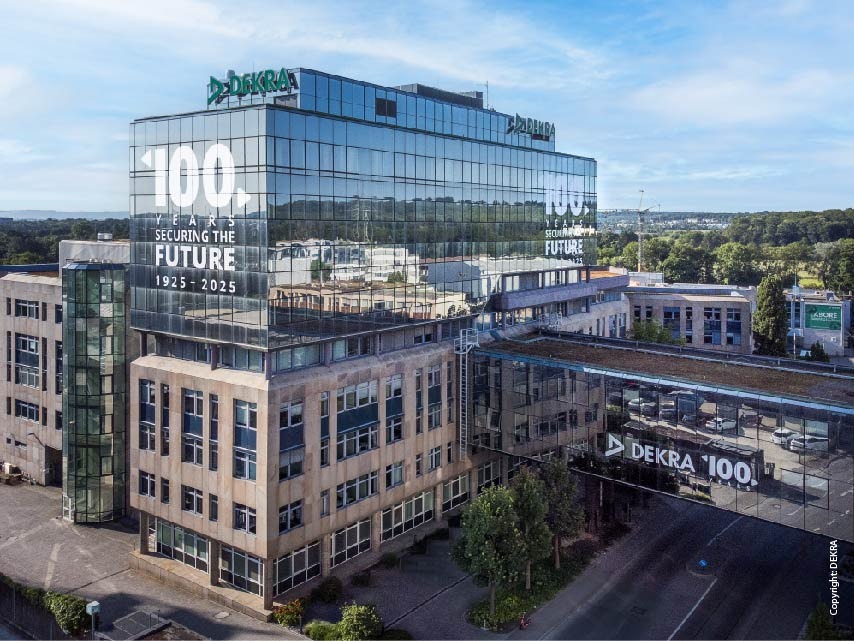
For more than 100 years, DEKRA has stood for safety. Founded in 1925 with the original goal of ensuring road safety through vehicle inspections, DEKRA has grown into the world’s largest independent, privately held expert organization in the field of testing, inspection, and certification. Today, as a global partner, the company supports its customers with comprehensive services and solutions to further advances in safety and sustainability. In 2025, DEKRA generated an annual revenue of 4.4 billion euros. More than 48,000 employees provide qualified and independent expert services in approximately 60 countries across five continents. With a Platinum rating from EcoVadis, DEKRA ranks among the top 1 percent of the world’s most sustainable companies. In the spring of 2026, DEKRA became the first testing laboratory to be officially accredited for biometric AI systems in accordance with the EU AI Act.
With netinsight, DEKRA lays the foundation for centralized planning and billing of global IT services
Centralized management of IT service costs
With its Strategy 2030+, DEKRA is driving targeted growth in the areas of mobility, digital trust, and sustainability. Internally, Chief Digitalization Officer (CDO) Petra Finke is driving the digital transformation forward. Her goal: technologies should become so understandable and accessible that employees can use them confidently and digital development continues to gain momentum. In addition to modular platforms and digital services, the shift toward a hybrid IT model with both centrally and locally delivered services is also contributing to this.
This promises efficiency gains but initially requires significant organizational effort in the area of IT Financial Management (ITFM), as well as international transparency and standards within the central IT Controlling & IT Financial Management department in Stuttgart. “The number of IT services we manage in ITFM has increased fivefold as a result over the past few years,” says DEKRA ITFM Manager Julian Sauer, outlining the steep growth curve.
Increasing complexity as a key challenge
The real sticking point is not just the growing number of services, but above all their high complexity. “We distinguish between final and preservices – and in some cases, multiple preservice levels are nested within one another,” explains Sauer. The result is a complex service model intended to make IT service costs more transparent, but which is difficult to manage and understand. The previous Excel‐based model clearly reached its limits: “Different templates and versions, varying representations, an inconsistent database – often, plans could only be understood with the help of the original ‘creators,’” reports Lukas Eichhorn (IT Controlling & IT Financial Management, DEKRA SE). Therefore, the decision to adopt an ITFM software solution was an obvious one and was actively supported by the DEKRA Executive Board from the very beginning.
A common technical vocabulary also had to be developed first, which further strengthened collaboration. “The collaboration was consistently constructive and characterized by a clear focus on solutions,” emphasizes the ITFM manager.
Planning transparency at the touch of a button Go‐live as planned in April 2025: “That was a real ‘aha’ moment,” recalls Lukas Eichhorn. “Instead of isolated Excel spreadsheets, we were now able to analyze the planned costs for our IT services end‐to‐end at the touch of a button for the first time.”
Since then, the ITFM process has been continuously expanded: A monthly actual cost comparison enables factbased management and better costoptimization.
The greatest benefit: significantly greater transparency. For example, this made it possible to identify incorrect daily rates. “Discrepancies that had a direct impact on costs,” says Julian Sauer. Errors that previously went undetected are now immediately apparent.
Costs that were previously not taken into account are now being identified. This allows services to be realistically evaluated and calculated. In addition, DEKRA now has a solid foundation for making informed decisions in IT management. This contributes measurably to the optimization of the IT cost structure.
netinsight impresses with its adaptability
netinsight impresses with its adaptability
To find the right solution, the DEKRA project team created a weighted evaluation matrix. Three requirements were at the top of the list: intuitive cost planning, transparent presentation of costs and revenues, and minimal disruption to existing processes.
During the selection process, netinsight identified as the solution that met the defined requirements for transparency, flexibility, and integration. Although the nicetec software already covers many of DEKRA’s requirements in its standard configuration, it was clear that certain specific features would have to be implemented using the solution’s flexible configuration: “ITFM solutions are typically based on annual cost planning. However, we calculate many of our services over several years,” explains IT Controller Lukas Eichhorn. “The solution enables the mapping of specific requirements, such as multi‐year calculation models.”
Tight schedule requires clear priorities
The project kicked off in February 2025, and the next planning and costing cycle for IT service costs began as early as the start of April. “So there were just eight weeks between the kick‐off and go‐live,” recalls Julian Sauer, who was responsible for the implementation project together with his colleague Lukas Eichhorn. To stay on schedule, the project team set clear priorities and initially focused on planned cost control. “That was the crucial first step,” Lukas Eichhorn reflects.
At the same time, extensive implementation work was required: setting up the infrastructure in the DEKRA Cloud, migrating data, configuring and calculating multiyear planning, and, of course, training for the team and service owners.
Further expansion of the ITFM solution planned
With this, DEKRA has reached an important milestone on the path to automated IT financial management. In the long term, the solution aims not only to ensure transparency but also to make the actual value of IT services measurable. “With the help of the solution, key questions regarding costs, usage, and optimization potential for all services can be answered in a targeted manner,” emphasizes Lukas Eichhorn.
In the future, the allocation of IT service costs to service recipients will also be automated via the solution. “The foundation has been laid – now the focus is on further scaling and leveraging the potential,” summarizes Sauer.

As a globally active expert organization, DEKRA has stood for safety, quality, and trust for decades. Whether in vehicle inspection, industrial inspection, occupational safety, or digital solutions, DEKRA supports companies across a wide range of industries with comprehensive expertise and innovative services. In doing so, the company is committed to actively shaping safety and sustainability in an increasingly connected world. Read this case study to discover which challenges were successfully addressed and which project goals were achieved.
Download the DEKRA case study as a PDF (674 KB) now.


